
Mixed Martial Arts
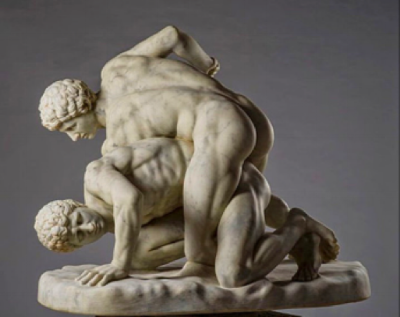
Two bodies drenched in sweat; Intertwined around each other, thrusting towards each other; seeking impact and mingling limbs, flesh to flesh. Hard breathing and shiny skin. Focused and intense looks. Salient muscles. The air around them is thick. They seem connected by some sort of magnet that switches polarity erratically. They clearly seek to touch each other, to connect, with alternating movements of attraction and repulsion. This is about power and vulnerability, ego and confidence. They are locked yet their posture suggests constant motion. The moment is very intimate yet exposed for everybody to see. The tension is palpable. Everything in their demeanor suggest an erupting volcano of emotions. It is raw and primal. The millions of years of evolution that turned homo sapiens into the dominating specie of the planet, have been stripped away from this choreography. It is the unscripted encounter of two bodies without editing. Since the dawn of time, humans have engaged each other this way. Nothing else is needed, no tools just limbs, no words just grunts. It is a language on its own that transcends ages and cultures… it is in fact one of the oldest and most primitive form of human interaction the world has known. It is fighting. More specifically, this is Mixed Martial Art, a contest of hand to hand combat of extreme violence, where only few things are off limits (groin shots, eye pokes etc.) and the goal is to knock out or submit the opponent.
We have become passionate about MMA. At first, we did not seek it. We would only watch when occasionally stumbling upon fights on television. The thrill was always compelling. For some reason, even if we did not know the fighters we would immediately have a favorite and watch with our heart in our mouth, clenching our fists and jaw as the two athletes would punch, kick and grapple. Then, as we became more familiar with it, recognizing patterns in the fights and certain specific fighters, we started to follow from afar. Soon curiosity and lust for this violence got the best of us and one day we purchased our first card on pay-per-view, and quickly became engaged. We now follow the sport’s biggest league, the UFC (Ultimate Fighting Championship), and buy most pay-per-view events. Most of all, on several occasions, we have traveled to go see fight cards live. In fact, UFC events make for good drifts. We have gone to Atlanta, Buffalo, Cleveland and Las Vegas to watch fights. We discovered those cities and met fellow drifters because of it. Fast forward a few years, we are now totally into it.
So why is it that we are still grappling with our feelings about the sport? Why doesn’t feel like any other sport? Our relationship with MMA is as passionate as it is ambiguous. We love to talk about it, to socialize around it, and yet it is still a stressful experience to watch it with surges of adrenaline, sweaty palms and rushing heart rate… It feels like fear but with something more complex and subtler. It is the fear that comes from the forbidden fruit.
Fact is, regardless of the exponential growth of its popularity over the last twenty years and its burst into the mainstream from the shadows of the underground, cage fighting is not just like any other sport or endeavor. Although MMA is a high-risk sport with potentially dramatic consequences (terrible injuries, CTE…) which is undeniably part of what makes it so attractive, it is not unique this way. Other sports such as race car driving, sky diving, football, competitive skiing, are equally or more dangerous. MMA is a brutal, bloody and unforgiving sport but what makes its unique are the intentions and instincts that are involved. To compete, the fighter must dig deep to muster pure aggression, build a profound desire to hurt his opponent, to shut him down, to rob him of his confidence, to establish his physical and mental dominance and prevail. Only in fighting are those instincts not a mere by-product, or an occasional source of inspiration but the very heart of the sport.
The intention, the element of willful aggression, is what is so unique to combat sports and gives them its forbidden taste. MMA has pushed the aggression factor to the extreme, as rules are kept to a minimum, to let combat occur as closely as it would “in the street” making only compromise to ensure it can result in a good televised show. This way, it is a pornographic representation of violence.
por·nog·ra·phy (noun) [pôrˈnäɡrəfē]: depiction of acts in a sensational manner so as to arouse an intense emotional reaction.
Obviously, we do not cast any sort of moral judgement on those who watch pornography (we do) or participate in any capacity to its production. We do enjoy some forms of it among which cage fighting the most. Pornography is an inherently human form of expression, our perception of which is shaped mainly by how we relate to the object represented. Our relationship to those objects, such as fighting or sex, are highly contingent of the mainstream culture and its dominating values. Cage fighting is still illegal in France making the organization of MMA events impossible, but its practice is authorized. In the US, MMA was illegal in the state of New York until 2016! More intriguing yet is how fast female fighting became a mainstream popular sport. Probably because of the way and the people who promote it, female boxing never rose out of marginality. Only a few years ago, Dana White, the President of the UFC was saying that there would never be female division in his promotion. Yet the circumstances aligned, Ronda Rousey arrived, Dana White changed his mind, the zeitgeist was ready, and now females frequently headline MMA cards. The cultural line circling obscenity is constantly morphing and moving.
But pornography remains. It only depicts impulses and acts as old as humanity itself. Of course, with the information revolution of the past thirty years, volume and accessibility have literally exploded and invaded our day to day. It is therefore hypocritical and useless to argue against pornography in itself. It is just an unfiltered, purposely produced display of realities that transcend time, space and cultures. Conflict and its physical expression is at the core of humanity. As is sex. As is war. We were grappling with the same feelings when we watched, transfixed and thrilled, the executions of the Romanian dictator Ceausescu in 1989, and of Libyan dictator Gaddafi in 2011. These scenes where broadcasted on National television and running non-stop for days. There will always be pornography.
As far as communities are concerned, the line should be drawn where free, informed and educated consent is, as well as where the safety and protection of all participants organized. This should be standard and easy to agree upon. But what is morally acceptable or not should only be a matter of individual choice and the outcome of an introspection on the subject. The decision to watch pornography is entirely based on each person’s personal relationship with the object represented, her set of values, their ethos, their sense of moral and their emotions. This is where the line becomes blurry and dilemmas are hard to solve. How you relate with fighting, with war, with sex, will inform how you watch its raw, sensationalized representation.
As we were drifting in Madrid recently, vising the Prado Museum, our attention was called by an extremely vivid and beautiful sculpture: “The Roman Charity” by Antonio Sola.
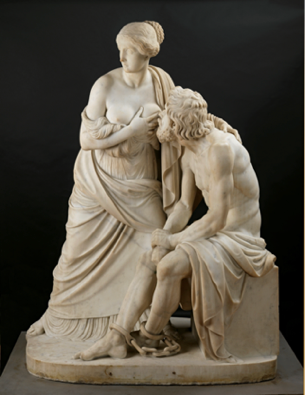
The representation of this theme is a good illustration of the struggle between art and obscenity, between nature and morals, and how it morphs over time, throughout cultures and personal sensitivity. Just a quick explanation of the theme. In the first century BC the Roman Historian Valerius Maximus wrote the story of Pero, a woman who breastfed her own father Cimon, who was incarcerated and sentenced to death by starvation. When she was discovered by his jailers the story went around and moved the public as an act of such selflessness and generosity that it became an icon, represented by many artists since the first century. The story seems to have been more a pretext used by artist to tickle the boundaries of acceptable morality and try to push the frontier of the obscene. The paintings and sculptures produced were an outlet for some very earthly men to express their deepest emotions. Below, the painting by Paul Rubens, in the XVIIth century.
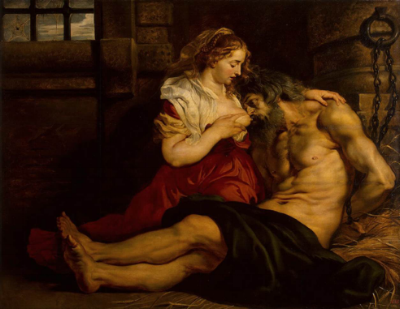
These works which are now unanimously considered masterpieces and throne in good place in museums seem to qualify as “depiction of [an] act(s) in a sensational manner so as to arouse an intense emotional reaction”. Looking at the statue in Madrid looking at the mastership, the detailed muscles of Cimon, heavy curve of her breast, the delicate folds of the cloth the movement conveyed in the body language of the corpse, her fear and haste, his exhaustion and relief, it is hard not to be intensely moved. As we stood there transfixed, we thought about MMA and Meryl Streep. A curious mental tangent…
At the 2017 Golden Globe ceremony, the extraordinary actress gave a good-hearted speech about tolerance and discrimination in which she made the following point: “Hollywood is crawling with outsiders and foreigners and if we kick them all out, you’ll have nothing to watch but football and Mixed Martial Arts, which are not the arts.” As fans of both Meryl Streep and MMA we were left witnessing the hailstorm of comments and reactions this was bound to cause in this this Trump-inflamed-identity-politics phase we are going through. On one hand, it is hard not to acknowledge how clumsy it was to frame things this way, opposing a worthy world of culture and civilization to a worthless world of primitive violence, especially when making a point about acceptance and against divisiveness. On the other hand, as MMA fan, we don’t find it insulting to say that cage fighting is not art. The debate over what’s art and what’s not is eternal and pointless. There was a time when “The Roman Charity” was probably discarded the same way and yet it is now in a museum. And what to say of Van Gogh whose vision was branded madness rather than art?
Heavy weight MMA fighter Josh Barnett may have had the reaction that, unwillingly, best summarizes the ambiguity that is inherent to the sport: “while it may not have the civil, often upper-class air to it that your art does, it is not devoid of talent, skill, training or schooling. It was around long before what you may consider 'the arts' to be, and would remain even if those arts were [to] disappear”. Indeed, cage fighting represents a scene of a human reality that transcends time, space and culture. Fighting transcends civilization. Conflict and its physical expression is at the core of humanity. As is sex. As is war. And there will always be efforts to represent it, show it, produce it. There will always be pornography.
Our struggle with MMA must therefore be exclusively internal and linked to deep emotional and intellectual roots. This mental environment makes us look away when we drive by a car crash, but watch the execution of brutal dictators, cage fighting and occasionally, people fucking. Fact remains, we have an uneasy peace with MMA. Not because it is pornographic nor because it is inherently violent, but because at its core, it is fueled by aggression and the will to hurt someone else, and because although the sport involves consenting adults, we doubt that any free will exist in any “consent”.
In the end, it is not about morals, violence or art… It is about consent. That is probably where the root of our grappling feelings for the sport are. Because we do not believe in free will. This in itself should be the subject of another essay (which we will eventually write) but in substance, just as we did not decide the composition of our DNA, which country we were born in, which family, we did not have any control over the first few years of everything happening to us, setting the base-structures of our character, everything that subsequently happened was the outcome of a perpetual chemical chain reaction on which our will has only an insignificant, marginal impact. This means that at any given time, our consent or dissent is not the isolated outcome of our intellect, performed in a bubble as if in a science lab where all other variables could be kept out to draw conclusions on the effect of the experiment. In other words, our consent is a drop in the cascading flow of our life, the source, the course, the speed, the flow of which we had as much control on as if we were throwing a glass of water in rapid waters.
To understand this obviously wrecks the American genius that postulate that successful people owe all their success only to themselves, their resolve, their strength, their will. This vision obviously carries with it, albeit stealthily, its negative version, that unfortunate people are responsible for their own demise because of their lack of those same qualities that explain success. Inequality is part of the equation, at every second of everyone’s story, from the moment Human History started in the plains of Africa. We are not all equal, yet in front of one particular situation, we are made equal by our ability to consent or dissent.
How does this translate in MMA? Well, let’s ask the question to any MMA fan, if their child had exceptional athletic abilities and could turn pro in any sport, which one would they choose? We are willing to bet that MMA will not even appear in the list. UFC President Dana White said it best and summarized it all:
“Conor might not ever fight again. Guy’s got a fucking 100 million dollars! You know? (…) Fighting is the worst. Try getting up and getting punched in the face every day when you’ve got 100 million dollars in the bank”.
A lot of fighters say that you need to be hungry to fight, not just metaphorically speaking. How many boxers and MMA fighters reached the top and lost their drive once they had made the kind of money that can free them from the sport? When was the last time an NBA star said “hey I got millions of dollars in the bank, I retire from basketball”? Never that’s when.
So, consent indeed. But if you live in an affluent family and are going to Harvard, you will not try to be a pro MMA fighter. If you are 6’8” and 250 pounds, and the ball is easy in your hand you might try for the NBA… What does the consent of a fighter really mean? It means he’s willing to risk his physical integrity to pursue the dream of a profession athlete carrier to rise above whatever circumstances, emotions, story he has. So many fighters have suffered from poverty, or abuse in one way or another. Yet consent is all we can reasonably require as there is no better cursor in a free country to inform us on the willingness and desire. We can’t question the nature and background of all consents (why did your husband decide to marry you?) But this is why we cannot be totally at peace with our passion for MMA. No one would choose a path of suffering, of brutality and aggression if they deeply felt there were other options out there that could fulfill their needs the same way. This is not Sparta anymore.
This leads us to the last monkey wrench that impedes us from being totally relaxed while enjoying MMA. When Josh Barnett pointed out to Meryl Streep that fighting was older than the arts she was talking about and would probably outlast them, I’m not sure he realized this is a very sharp double-edged sword of an argument. The whole drive of civilization has been precisely to channel, control, domesticate or overgrow our natural impulses. That art was the fruit of an evolution, in which at some point, humans started to seek beauty for its own sake and produce without any concern for primal instinct of survival, can only be seen as positive. That our cultures are not entirely built around breeding warriors, or does not allow gladiators to fight for their life and freedom in the Coliseum, is usually considered a positive evolution. But as we mentioned, the personal and culture lines that are drawn to divide the obscene from the entertaining, the mainstream from the marginal, are blurry, fast moving and unpredictable. No one is shocked to see two women on television throwing elbows and kicks at each other. Yet we would have been horrified ten years ago… The impulses that were at play in the Roman games are the same that are at play in MMA today. We just moved the lines a few inches left and right. What if tomorrow death row inmates were offered the possibility to have their life spared in exchange of a fight to life and death? What if we were to offer them life in prison if they win instead of the death sentence? What if some inmates consented to do it? On television. How long would that take for that to seep in and settle into the mainstream? Read Stephen King’s “The Running Man”. By the end of the book, what is shocking is the duplicity of the system rather than the idea itself. For some trends, the question is more when to draw the line rather than where. When consent is at the center of the mix, all we have is our own conscience to decide.
It’s Saturday and we’re excited. There is a big UFC card tonight. Some of the most exciting fighters will compete. Drama has been building up. The competitive and personal stakes have been boiling for weeks. We are excited. And we are nervous already. We have started our own internal wrestling. We will watch. We will enjoy. But we are still not sure we should. Of course, some well-chosen psychedelics will settle it. Cannabis induced drift makes fighting much more enjoyable. In the distorted perception of time and space that comes with it, fights seem eerie. For a moment liberated from the kung-fu grip of the ego, somehow connected to the wholeness of the universe, with nothing standing by itself, it seems fighting is just a transfer of energy. The kicks and punches seem to be liquid, the grappling seems like live statue carving, and the beauty of it all becomes infinite. Some psychedelics turn everything into art…